Why your trash cart starts to stink (and what 200°F water actually does about it)
The Kennewick summer sun turns a garbage cart into a slow cooker. Here is the cleaning science we lean on — and why a $20 driveway rinse doesn't cut it.
By Tri-Cities Fresh Bins
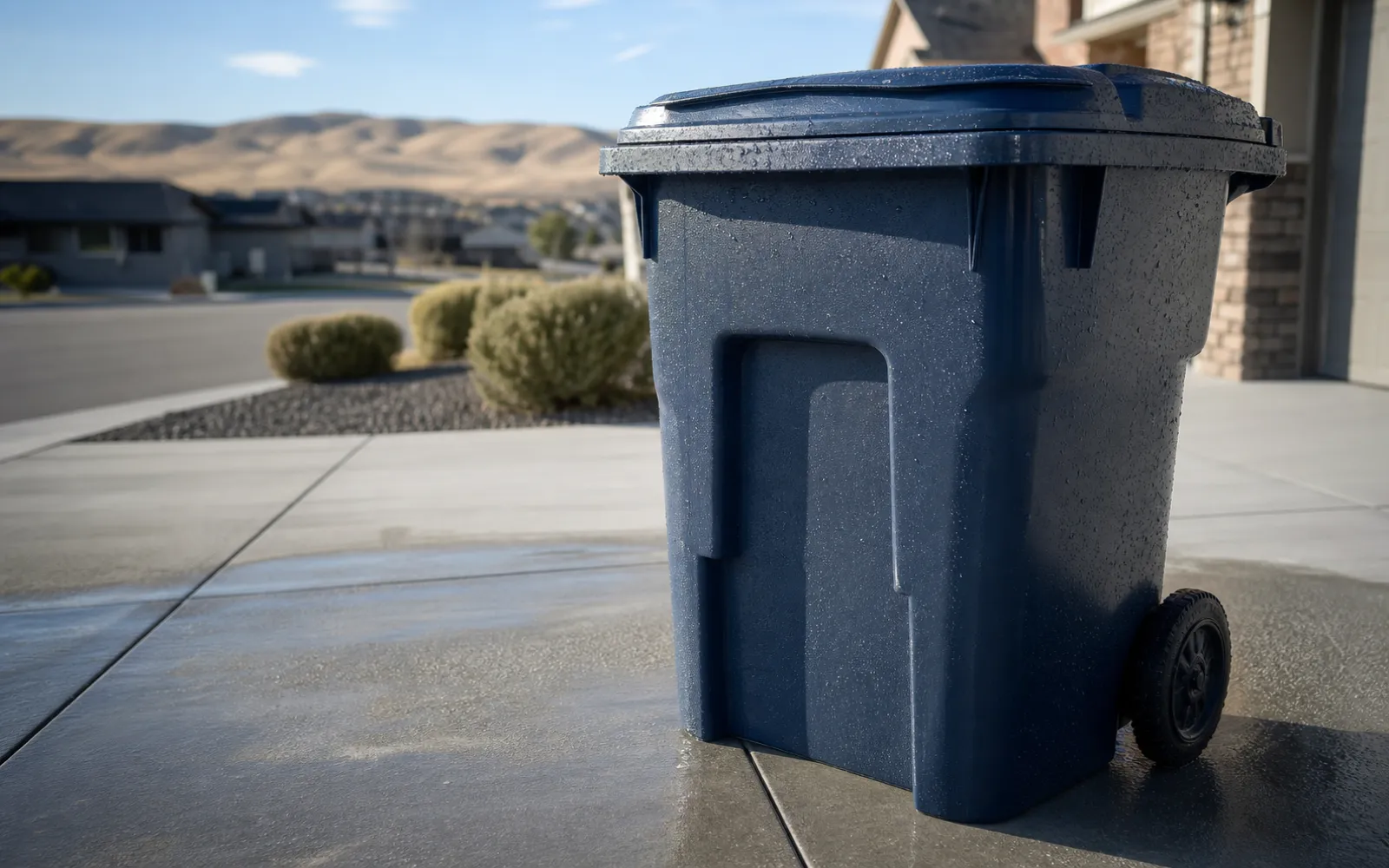
Every Tri-Cities homeowner has had that moment. You wheel the empty cart back from the curb in late July, lift the lid, and immediately wish you hadn’t. That smell isn’t a mystery — it’s months of food residue, juice runoff, and bacterial colonies cooking in 95-degree Kennewick heat with the lid closed. A cart in our climate becomes its own little compost reactor between pickups.
What’s actually growing in there
The film coating the inside walls of a residential trash cart is a mix of:
- Putrescible organics — leftover food, meat juices, yard debris.
- Biofilm — bacterial colonies that anchor to the textured plastic and shrug off cold-water rinses. This is the layer that smells.
- Mold spores — especially after a wet Richland spring, where lids trap humidity and the cart never fully dries between hauls.
Cold-water rinsing knocks loose the visible chunks but leaves the biofilm intact. Bleach kills surface bacteria but doesn’t dissolve the organic matter feeding them — which is why a bleached bin smells like a chemistry classroom for two days, then smells like a trash bin again.
Why hot water changes the game
Heat is the lever. Above roughly 160°F, most household bacteria denature and the protein-based biofilm releases its grip on the plastic. We run our pressure washers at 200°F at the nozzle — well past the denaturation threshold, hot enough to liquefy congealed grease, and far beyond what a garden hose or even most rental washers can produce.
Combined with mechanical pressure (around 2,000 PSI at close range), we’re scouring the textured plastic clean rather than just rinsing the top of the gunk. The wastewater is captured on the truck so it doesn’t hit Pasco storm drains.
Where the eco part lands
Our detergent is plant-based and biodegradable — it breaks down inside 30 days. We don’t use chlorine bleach or quaternary ammonium sanitizers. And because we capture every drop of wastewater on the truck and dispose of it at a licensed facility, none of it ends up in your yard, your driveway, or a Pasco storm drain. The finishing spray is a citrus extract, not a fragrance bomb.
What you actually notice
Customers tell us two things consistently:
- The cart stops smelling like a cart. It smells like nothing — the way a cart is supposed to smell.
- Fly pressure on the patio drops noticeably within the first cycle. The flies are coming for the residue, not the cart itself, and once the residue is gone they stop loitering.
That’s the whole pitch, really. We replace “I should hose that out someday” with “it’s already handled.” If you want to see it on your own driveway in Kennewick, Pasco or Richland, get on the route.
See also
- Bin cleaning in Kennewick, WA — Southridge, Canyon Lakes, Vista Field
- Bin cleaning in Pasco, WA — West Pasco, Road 68, Riverview
- Bin cleaning in Richland, WA — Meadow Springs, Horn Rapids, Queensgate
Get on the route in Kennewick, Pasco or Richland.
Tell us your address and pickup day. We'll text back within the business day with a quote.
Get a quote