Is bin cleaning actually eco-friendly? (Yes, but here's the honest answer)
We capture our wastewater, use plant-based detergent, and keep the route tight. Here's what "eco-friendly" really means when you read it on a bin-cleaning truck.
By Tri-Cities Fresh Bins
Half the bin cleaning websites in the Pacific Northwest plaster “eco-friendly” across the homepage and call it a day. We try to be more specific than that, partly because the Columbia River runs through our service area and a stormwater violation isn’t an abstract problem in Richland.
Here’s what eco-friendly actually means for our trucks, plainly.
We capture the wastewater
This one is the big one. The water and residue blasted off your trash cart has to go somewhere. Companies that skip capture let it sheet across your driveway and into the nearest storm drain — and Tri-Cities storm drains feed directly into the Columbia and Yakima rivers without treatment.
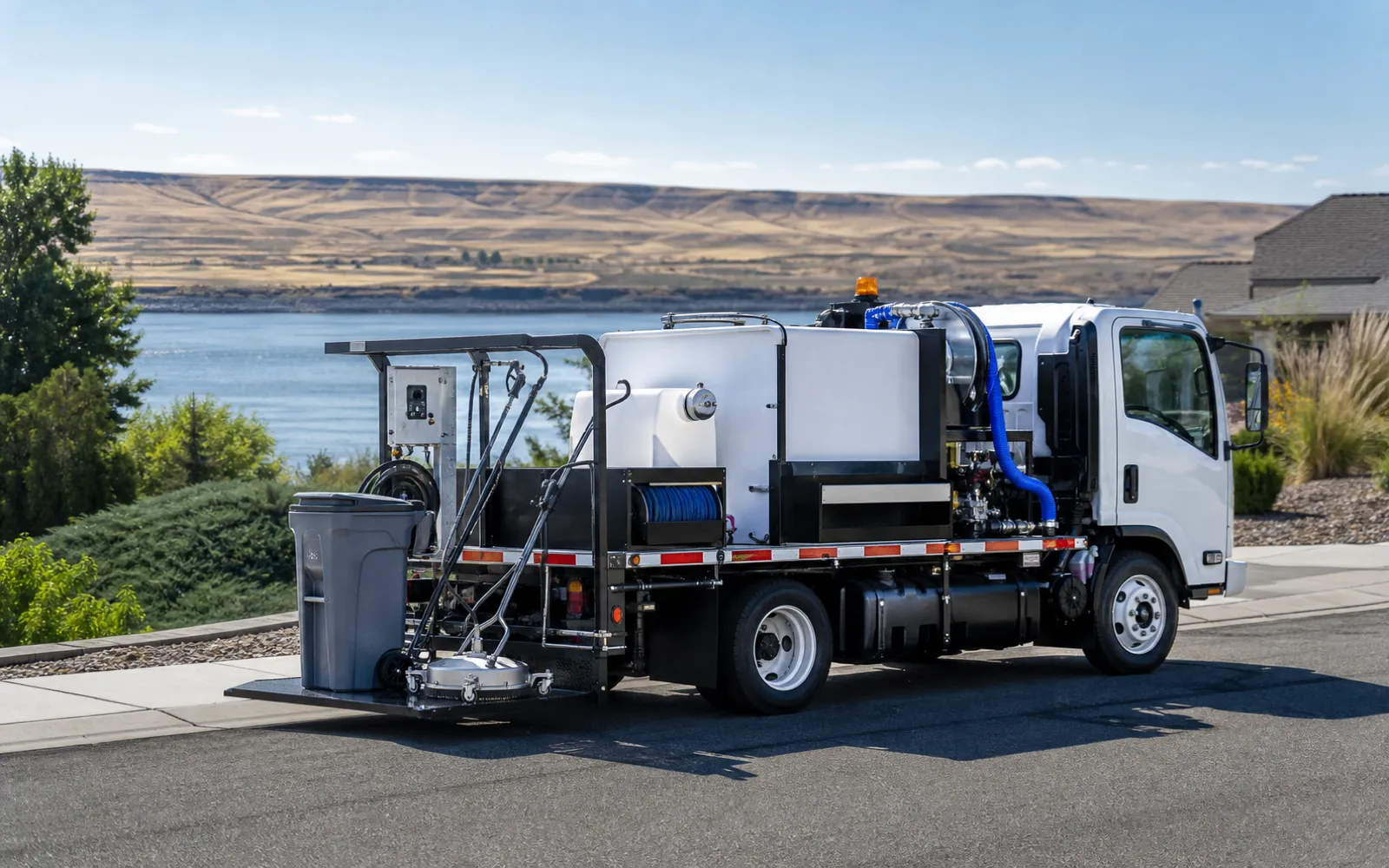
Our trucks are built around a closed-loop system:
- Vacuum recovery mat under the cart catches everything during the wash.
- Onboard wastewater tank holds the dirty water for the whole route.
- Filtered transfer at end-of-route into a sanitary disposal partner — the same kind of facility that handles RV blackwater.
Your driveway dries cleaner than we found it.
We use plant-based detergent
Our cleaning agent is plant-derived and biodegradable. It breaks down in roughly 30 days under standard wastewater conditions. Specifically what it isn’t:
- Not chlorine bleach (off-gasses, harsh on aquatic life).
- Not quaternary ammonium (“quats”) — common in industrial sanitizers, but rough on aquatic life.
- Not fragrance-loaded. The post-clean scent is a citrus extract, used in a thin enough application that you mostly just smell “nothing,” which is the right answer for a trash cart.
We keep the route tight
This one isn’t glamorous but it matters: we run dense routes. We batch nearby addresses together rather than bouncing across the Tri-Cities and adding unnecessary diesel miles. The denser the route, the less fuel per cart cleaned, the less wear on the truck. Most weeks each truck cleans 80-plus carts on a single fill-up.
What “eco-friendly” doesn’t mean
A few things we wish folks would stop claiming:
- “Solar-powered.” It’s a truck. The truck is diesel. The pressure washer is diesel-fired (you have to be — that’s how it gets to 200°F).
- “Carbon-neutral.” Not without offsets we’re not buying.
- “Chemical-free.” Water is a chemical. So is plant-based detergent. The honest claim is “responsible chemicals.”
Where this lands for you
If you’re picking a Tri-Cities bin cleaner partly because the Columbia matters to you — we get it, it matters to us too. Ask any provider you talk to whether they capture wastewater. If the answer is “uh, it just runs off,” that’s the answer.
Get a quote from us here and we’ll show you the capture system on the first clean.
See also
- Bin cleaning in Richland, WA — keeping runoff out of the Yakima River
- Pressure washing in Richland, WA — same on-truck capture for driveway and siding work
- Pressure washing in the Tri-Cities — what wastewater capture means for a driveway wash
Get on the route in Kennewick, Pasco or Richland.
Tell us your address and pickup day. We'll text back within the business day with a quote.
Get a quote